Session 16-C Chesnutt’s Craft: Writing and Revising Stories and Myths
Saturday, May 27, 2023, 10:00-11:20 am
Organized by the Charles W. Chesnutt Association
Chair: Bill Hardwig, University of Tennessee
- “The ‘Renaissance of Chivalry’: Remaking Race and Rewriting History in Charles Chesnutt’s The House Behind the Cedars,” Amina Gautier, University of Miami
This paper focuses on the extended tournament scene in chapter five of Charles Chesnutt’s The House Behind the Cedars (1900) to explore the ways in which Chesnutt mocks the mock tournament and uses dramatic irony to depict white southern attempts to rescript southern history, by inscribing it with medieval heritage and replace southern defeat in the Civil War with staged performances of southern valor.
- “Pain, Conjure, and Storytelling in Charles Chesnutt’s Uncle Julius Tales,” Jamie Utphall, Ohio State University
This talk comes from a chapter of the same name from my dissertation, Pain Management in Nineteenth-Century American Literature. Across the Uncle Julius tales one way Chesnutt identifies the color line is in terms of the nineteenth-century’s differing approaches to white and Black pain. Exploring the complex relationship between pain, conjure, and storytelling, Chesnutt seeks to demonstrate how storytelling is a critical part of mitigating and preserving the legacy of slavery, especially in regard to intergenerational trauma. While slavery’s horrors can never be resolved, nor should they be erased from the past, Chesnutt demonstrates how storytelling can provide an avenue through which such pain might be mitigated, memory restored, and stolen voices reclaimed. Utphall provides a close reading of Chesnutt’s 1901 essay “Superstitions and Folk-lore of the South,” in which Chesnutt criticizes the logic conjure but reveals how storytellers bear great responsibility in how they manage and transmit stories to their audiences and futures generations.
- “‘For She is of Our Blood’: Chesnutt’s Manuscript Revisions in ‘The Dumb Witness,’” Antje Anderson, University of Nebraska-Lincoln/Hastings College, and Stephanie Browner, The New School
This paper sheds light on Chesnutt’s writing process. Based on the collation they have prepared for the forthcoming Complete Short Stories of Charles W. Chesnutt with Oxford University Press, Anderson and Browner provide a fine-grained analysis of the revisions Chesnutt made as he drafted “The Dumb Witness,” a story he incorporated into his 1905 novel The Colonel’s Dream, but never published by itself, despite submitting it twice. In the two manuscripts for this story, we see Chesnutt, an inveterate reviser, modulating his treatment of race, race relations, and mixed-race characters with extraordinary clarity.
Session 19-B Labor of Love: Work in Chesnutt’s Fiction
Saturday, May 27, 2023, 2:00-3:50 pm
Organized by the Charles W. Chesnutt Association
Chair: Stephanie Browner, The New School
- “Let it rijos di oprest: Chesnutt and the Liberatory History of Stenographic Rhetorics,” Susanna Ashton, Clemson University
By the 1870s, when an ambitious young man of mixed race in Fayetteville, North Carolina, began to teach himself stenography, it was no longer coupled in the popular mind with the abolitionist reforms that had helped initially launch it in the United States. It was seen primarily as a tool for advancement in the world of law and business. Nonetheless, when Charles Waddell Chesnutt decided to learn shorthand, he engaged with a practice historically inflected with notions of freedom, racial equality, and justice in a way that might be hard for us to apprehend today. That his stenographic career supported his artistry for many years is certainly true, but his career as a stenographer also shaped the way he could imagine and represent the racist world around him. Ashton’s presentation looks at the historic use of stenography as a tool of anti-slavery activists and how that informs the ways in which Chesnutt’s fiction can be seen as shaped with a stenographic rhetoric.
- “Charles Chesnutt and the Economic Fiction of Transformation,” Alex Moskowitz, Mount Holyoke College
This paper thinks through Chesnutt’s “Po’ Sandy” to imagine what it might be like if the imperceptible enslaved human labor embedded in objects were to become perceptible. This paper uses “Po’ Sandy” as a jumping off point to think about the normalized transformation of Black laborers into laboring objects. Moskowitz argues that Chesnutt plays with the literal and figurative levels of the story to put pressure on the insensible social nature of embodied value: Sandy’s literal transformation into a tree becomes a vehicle for conceptualizing the figurative real-world transformation of enslaved Black laborers into laboring commodities. As a writer thinking through slavery’s persistence even past its formal abolition, Chesnutt’s work is here put into conversation with scholars such as Christina Sharpe to think about the economic waves that follow in “the wake” of slavery’s afterlives.
- “Health Justice and The Marrow of Tradition,” Ira Halpern, Northeastern University
This paper interprets the politics of health care in Charles Chesnutt’s The Marrow of Tradition (1901) alongside Chesnutt’s speech “The Ideal Nurse” (1914) to trace how Chesnutt critiqued segregation in medicine. Halpern places The Marrow of Tradition within the historical context of the emergence of the Black hospital movement. As the paper suggests, Chesnutt offers in Marrow a wide-ranging critique of the social and infrastructural conditions affecting Black health, and a sense of the potential possibilities of professional medicine as a mechanism of health justice.

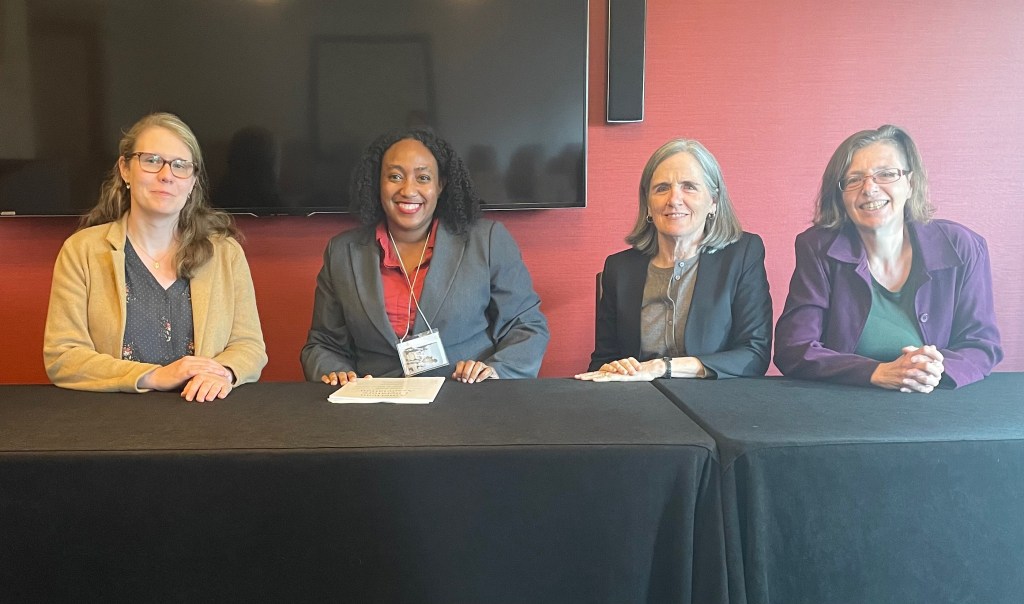
with presenters Alex Moskowitz, Ira Halpern, and Susanna Ashton
 chesnuttassociation.org