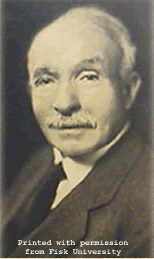
“I will live down the prejudice. I will crush it out. I will show to the world that a man may spring from a race of slaves, and yet far excel many of the boasted ruling race.”
Charles W. Chesnutt
Chesnutt’s life (1858-1932) spanned crucial moments in American history – the Civil War, Reconstruction, the rise of post-Reconstruction violence, the establishment of schools for black children led by black teachers, the emergence of the convict-labor system, and the beginnings of the Civil Rights Movement. He was born in the North to parents who fled North Carolina before the war and returned there before the Fourteenth Amendment was adopted. During Reconstruction Chesnutt’s father was a county justice of the peace and joined with other African American men to buy land on which, with Freedmen’s Bureau help, they built a public school, which Chesnutt attended. By the time he was sixteen and Reconstruction was faltering, Chesnutt was teaching in schools in North Carolina and South Carolina. Unable to attend college, Chesnutt continued to educate himself in his spare hours, practicing four languages, as well as Pitman shorthand, literary composition, and the organ. At eighteen returned to Fayetteville to serve as assistant principal of the school he had attended as a boy. By an act of the North Carolina General Assembly a few years earlier, it had become the State Colored Normal School, the first in the state for African American teacher training. In 1883, having trained himself in stenography, anticipating that skill in this new technology would open up business and career opportunities (which it did), he left North Carolina to look for work in New York, where he worked briefly as a Wall Street reporter for Dow Jones & Company. Later that same year, at the age of twenty-five, and as violence against African Americans continued to rise, he moved his wife and three children to Cleveland, where he passed the Ohio bar with the highest score in his group and grew a stenography business that put Chesnutt at some of the most important cases in the city by the turn of the century.
Chesnutt’s writings are remarkably varied in genre, style, and voice. As archival materials and correspondence reveal, he worked at his craft, revising and reshaping work again and again. He was also prolific. Writing in every genre, he probed deeply and imaginatively, with both an ethical sense and a capacity for play, some of the most complex issues in American society. At seventeen he placed his first short story in the Fayetteville Educator; at twenty-two, he declared his calling in his journal. He began publishing in earnest at twenty-seven, and within five years he had placed thirty-nine short stories, including three in the Atlantic Monthly, the first African American author to do so. His works appeared through syndication in newspapers across the country, and he published in both the white and black press. By 1905, he had published six books – two collections of short stories, three novels, a biography of Frederick Douglass – as well as essays, poems, and additional stories in magazines. After that, civic duties in Cleveland grew, and he returned to his stenography business. But he continued to write: he delivered or published more than twenty-five speeches and essays between 1905 and 1926, despite having a minor stroke in 1910. He also published a few more short stories, including four in The Crisis.
In 1920, his first novel, The House Behind the Cedars was serialized in the Chicago Defender, twenty years after its original publication. A few years later, in 1927, it was made into a silent film by African American director and producer Oscar Micheaux in 1927, and then again by Micheaux in 1932 with a revised plot. Chesnutt maintained friendships and correspondence with notable contemporaries including Booker T. Washington, W. E. B. DuBois, Albion Tourgee, George Washington Cable, Walter Hines Page, Horace Traubel, William Dean Howells, and others. By the time of his death, he had written nine novels, more than eighty short stories, and more than seventy essays and speeches.
Chesnutt’s fiction is taught in college classrooms across the country, and there are myriad editions available in print, including a handsome and comprehensive Library of America volume. Work is also underway for a scholarly edition of the complete works with Oxford University Press. Digitally, Chesnutt’s works can be found at Documenting the American South (look for Chesnutt entries) and also at the Charles Chesnutt Digital Archive, which also offers contemporary reviews, a complete bibliography, and images of manuscripts, and is now in the process of adding his correspondence.
The Chesnutt Association was founded to support open and inclusive discussion and scholarship addressing Charles Chesnutt’s life and work. Everyone is welcome.
Contact Us:
Please fill out this Google Form.
 chesnuttassociation.org